Monday, 12 March 2018

Post-top Outdoor Lighting Fixture - 2nd Design - Medium Size - 17"


The  page contains 'open details' of an outdoor post-top lighting fixture, we try to achieve and discuss about, for outdoor lights for esoteric purposes, for the outdoor environment of Light Communities, Areas of Light, and for Tachyon Chamber yards or Contact Zones.


- Maximal bulb power (HID) 400W, rated lumen output 40000lm.

- Lampshade size: height: 675mm/26.50in; top dia.: 424mm; base dia.: 335/430mm (base-up/base-down).

- Pole size: top end spigot/tenon dia.: 60mm/2.375in.;  recommended height: 3.00...3.60m/10...12ft for base-up lampshade, and 2.40...3.30m/8...11ft for base-down lampshade.


Details and 'blue prints' are given for  main components.


 1- POST-TOP FITTER:

1.1 - Pole fitter:


1.2 - Lampshade Fitter:


2 - Lampshade:


3 - Top Shield:   


The other pieces and assembly components are the same as to the regular size 14"/350mm outdoor post-top lighting unit: http://lightcommunitylighting.blogspot.com/2018/03/blog-post.html


Cobra's up to date post:
http://2012portal.blogspot.com/2018/03/blog-post_9.html


Saturday, 3 March 2018

Untitled Post


STAR COLORS  http://www.southastrodel.com/Page029bAmerican.htm

... 'saturated colors',... 'frequency colors,... 'sound colors',...'energy colors';...   which ones are ours we speak about?...


What is (or might rather be) for instance 'the Violet Flame'?...
a saturated violet, or rather a 'f2' spectrum of energy behind it??...
(as previous in discussion...)


...the 'saturated colors bulbs' on the market might be not saturated at all...

The color which gives a bulb to you may be not the same 'saturated' which your computer screen gives out...


WARNING!

Do NOT use 'unprotected metal halide lamps' in your home, none in 'open rated' lighting fixtures!...

ATTENTION!
What we discuss here about lighting is not a DIY (do yourself) home improvements idea...

What we name by knocking together nowadays tech is in the sense of putting together, but in a responsible manner, what is nowadays accessible technicaly, thus reach it or not our scope exactly...

Proposal of experiments are in discussion for only advised specialists or researchers, not for 'the average person'!! Keep this in mind...

Nor do we advise to lit HID lamps in your home or garage as in videos linked on subjects.

As our concern, we never light on a HID lamp on the research desk without a protective cage.

What you see in many videos is highly not recommended for an unadvised person.


Spectrum Tubes

Individually available for many optical applications; may be used for extending frequency spectrum of Lakhovsky machines:

https://www.amazing1.com/pages/health/body-energy-charging-machines.html

"The pure elements / gases under pressure in these tubes is generally used to produce a light for spectral analysis. Brightness of the light discharge depends on the power of electrical energy being supplied to the tube. The nature of gas determines the pure spectral color and usually is of a relatively low band width. All lamps contain metal ends with long-life electrodes. Lamps are about 26 cm (10 inches) long, with 90-100 mm of central capillary. Lamps are intended for intermittent use only at full power, and not for use as a lamp source. These are designed to operate 30 seconds ON / 30 seconds OFF. (They may be operated continuously when used with the LAKHOVSKY machine, as shown in the instructions for that device.) Requires a Spectrum Tube Power Supply (such as our low-cost NEON21 for do-it-yourselfers, or the finished 2154-1, both below) or our Induction Coil 1917-10 to operate, sold separately."


P.S. Not recommended to DIY, but only if you are at least an average specialist or researcher...


Cobra's up to date post:
http://2012portal.blogspot.com/2018/03/short-situation-update_2.html


Thursday, 1 March 2018

Post-top Outdoor Lighting Fixture - 2nd Design - Medium Size - 14"


This page contains 'open details' of a 'medium sized' outdoor post-top lighting fixture, we try to achieve and discuss about, for outdoor lights for esoteric purposes, for the outdoor environment of Light Communities, Areas of Light, and for Tachyon Chamber yards or Contact Zones.


- Maximal bulb power (HID) 250W, rated lumen output 20000lm.

- Lampshade size, app.: height: 700mm/27in; top dia.: 350mm/14in; base dia.: 260mm/10in.

- Pole size: top end spigot/tenon dia.: 60mm/2-3/8in.; recommended height:  3.00...3.60m/10...12ft.


Details and 'blue prints' are given for  main components.


1 - POST-TOP FITTER

1.1 Pole Fitter: 


1.2  Lampshade Fitter:  


2 - LAMPSHADE (Globe)  


3 - TOP SHIELD


4 - RODS 


5 - HEAD JOINT DISK 


6 - BOLT (STUD) => Assembly Details


7 - HEAD NUTS  


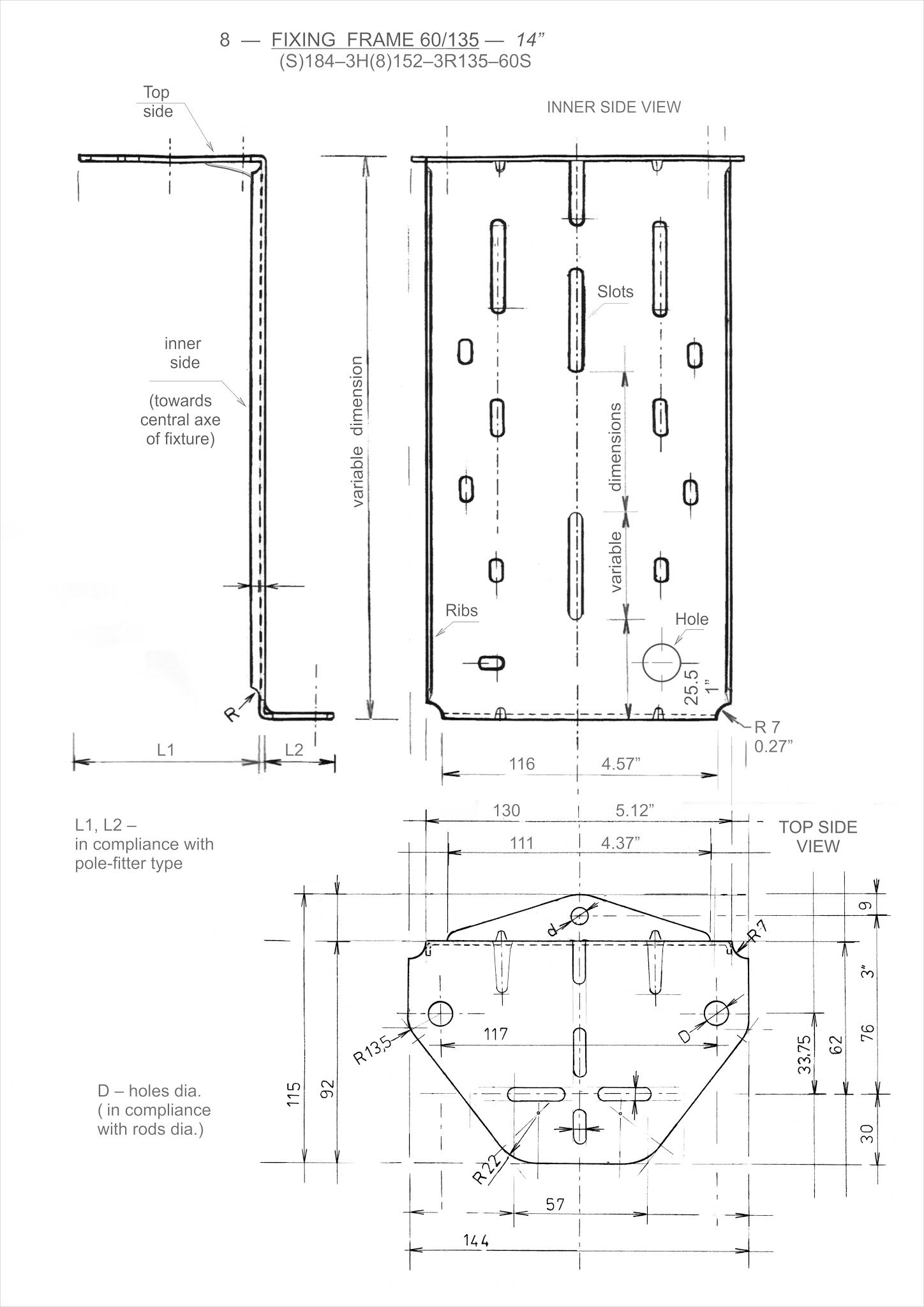
8 - FIXING FRAME 


Wednesday, 28 February 2018

Post-top Outdoor Lighting Fixtures - 2nd Design - Medium Size


A medium sized post-top outdoor luminaire is under designing, and open content will be available on this blog:


As expected to be the most utilized size for the described purposes, a wider range of neat surface lampshades will be designed for this one.


A 'Goldilocks' like is intent between a too large size and the condition to have an inner large space and a sufficient large area of lampshade. This is what we will try to achieve in a proper 'medium sized' outdoor light unit.

However it will not be able to host and work a mandala of 12 pink light tubes of 2ft, nor will it be it able to use an 1000W HID bulb 'fire white light', in the way the large size units will do.


Friday, 16 February 2018

Thursday, 15 February 2018

Post-top Outdoor Lighting Fixture - 1st Design - Large Size - 20"


This page contains an 'outline' of a 20" outdoor post-top lighting fixture, we try to achieve  for outdoor lights for esoteric purposes, for the outdoor environment of Light Communities, Areas of Light, for Tachyon Chamber yards and Contact Zones.


- Maximal bulb power 1000W, rated lumen output 100000lm.

- Lampshade size: height: 775mm/30.50in; top dia.: 500mm; base dia.: 400/545mm.

- Pole size: top end spigot/tenon dia.: 76mm/3in.;  recommended height: 3.00...4.20m/10...14ft for base-up lampshade, and 2.40...3.30m/8...11ft for base-down lampshade.


Details and 'blue prints' are given for  main components.


 1- POST-TOP FITTER

1.1 - Pole fitter - similar as to the regular size 16"/400mm outdoor post-top light unit,
 Two Pieces Post-top Fitter, B - Cramp/Screw fixed, 1.1 Pole Fitter:


 1.2 - Lampshade Fitters:  


2 - Lampshades:  


3 - Top Shield:  


The other pieces and assembly components are the same as to the regular size 16"/400mm outdoor post-top lighting unit: http://lightcommunitylighting.blogspot.com/2018/01/blog-post_22.html


Wednesday, 14 February 2018

Post-top Outdoor Lighting Fixture - 1st Design - Large Size - 18"


This page contains 'open details' of the 18" outdoor post-top lighting fixture, we try to achieve  for outdoor lights for esoteric purposes, for the outdoor environment of Light Communities, Areas of Light, for Tachyon Chamber yards and Contact Zones.


- Maximal bulb power 600W, rated lumen output 60000lm.

- Lampshade size: height: 775mm/30.50in; top dia.: 450mm/18in; base dia.: 365/480mm.

- Pole size: top end spigot/tenon dia.: 76mm/3in.;  recommended height: 3.00...4.20m/10...14ft for base-up lampshade, and 2.40...3.30m/8...11ft for base-down lampshade.


Details and 'blue prints' are given for  main components.


1- POST-TOP FITTER


1.1 - Pole fitter - similar as to the regular size 16"/400mm outdoor post-top light unit,
 Two Pieces Post-top Fitters:


1.2 - Lampshade Fitters:


2 - Lampshades:  


 3 - Top Shield:  


The other pieces and assembly components are the same as to the regular size 16"/400mm outdoor post-top lighting unit:  http://lightcommunitylighting.blogspot.com/2018/01/blog-post_22.html


Saturday, 3 February 2018

Understanding the Pink Light


It may be worth to be taken in consideration, and are we also entitled to consider, that in order to visualize properly the Pink Light, we have to understand it at least in 3rd density terms.

We are also entitled to consider that the 3rd dimensional visible veritable Pink Light is to a great extent the 3rd density counterpart of the metaphysical Pink Light which carries the energy we consider to anchor on the earth...

So, a proper understanding of it in the earthling physical terms, concerning its visible spectrum, will help us at an unconscious level to visualize what it in fact should be.


Think at first that the power of light frequency emission (relative to human perception) is proportional to 1/f (frequency). The more the light emission to the red, the less that is to the violet...


For the average person might seem very interesting the definition of 'pink sound', definition rooted on the analogy of what is from a spectral point of view the visible pink light.


https://en.wikipedia.org/wiki/Pink_noise


"Pink noise or ​1⁄f noise is a signal or process with a frequency spectrum such that the power spectral density (energy or power per frequency interval) is inversely proportional to the frequency of the signal. In pink noise, each octave (halving/doubling in frequency) carries an equal amount of noise energy. The name arises from the pink appearance of visible light with this power spectrum.[1] This is in contrast with white noise which has equal intensity per frequency interval."
=> source: https://en.wikipedia.org/wiki/Pink_noise


COLORS OF LIGHT and COLORS OF SOUND

An example of 'blue sound' and 'blue light':...

"Cherenkov radiation is a naturally occurring example of almost perfect blue noise, with the power density growing linearly with frequency over spectrum regions where the permeability of index of refraction of the medium are approximately constant."
https://en.wikipedia.org/wiki/Colors_of_noise

"Cherenkov radiation also appears as a bright blue color, for these reasons."
https://en.wikipedia.org/wiki/Cherenkov_radiation

"Blue noise is also called azure noise. Blue noise's power density increases 3 dB per octave with increasing frequency (density proportional to f ) over a finite frequency range".


An educated speculation,... or, let say it even 'assumption' might lead us to the idea by which these colours which we speak about are some kind more alike to the 'colors of sound' in higher dimensions, at least in the way in which might be comparable with 3rd dimensional physics, to be understandable.

i.e. the pink light we visualize might be a result of a '1/f' of a certain 'higher dimensional band' of 'frequency',... expressed at least in earthling understandable terms...


More detailed, the soft pink healing energy might be considered a kind of '1/f' (in 3rd dimensional understandable terms) of a certain 'band' of higher dimensional energy.

at least this may be our 'educated guess' from a particular point of view to a general one. (from 3rd dimensional to higher dimensional).

the same might be with the violet and others...


Violet light, and 'Violet Flame'...

How much 'violet',... and how much as a flame...

What is it?... a narrow band of hardly visible light of the end of the visible spectrum,... or a more brighter and wider spectrum of light?...


https://en.wikipedia.org/wiki/Colors_of_noise

Violet noise[edit]

"Violet spectrum (+6 dB/octave)
Violet noise is also called purple noise.
Violet noise's power density increases 6 dB per octave with increasing frequency[9][10] (density proportional to f2) over a finite frequency range."


In terms of light, yes, density proportional to f2 (square of f), but it also depends 'how much' over a finite frequency range?...

What we can say, is that it should be as much as not to reach the end of spectrum (at red bands) with its lowest value, but however as near towards the 'red' band... so that to have a reliable lumen output for the light source...


The Pink Egg Light.
Something that we have to bring in a more visible form...


There is the intent to create a veritable pink light egg shaped light source with the scope to bring into the 3rd dimensional world the metaphysical pink egg full of energy of Love, as it's 3rd density visible counter part.


Cobra's up to date post:
http://2012portal.blogspot.com/2018/02/situation-update.html