Tuesday, 1 September 2020

The Fluorescent Excimer Lamp


Another kind of source of light colors for esoteric use and general lighting


Q and A - Researchment proposal, questions and expectations


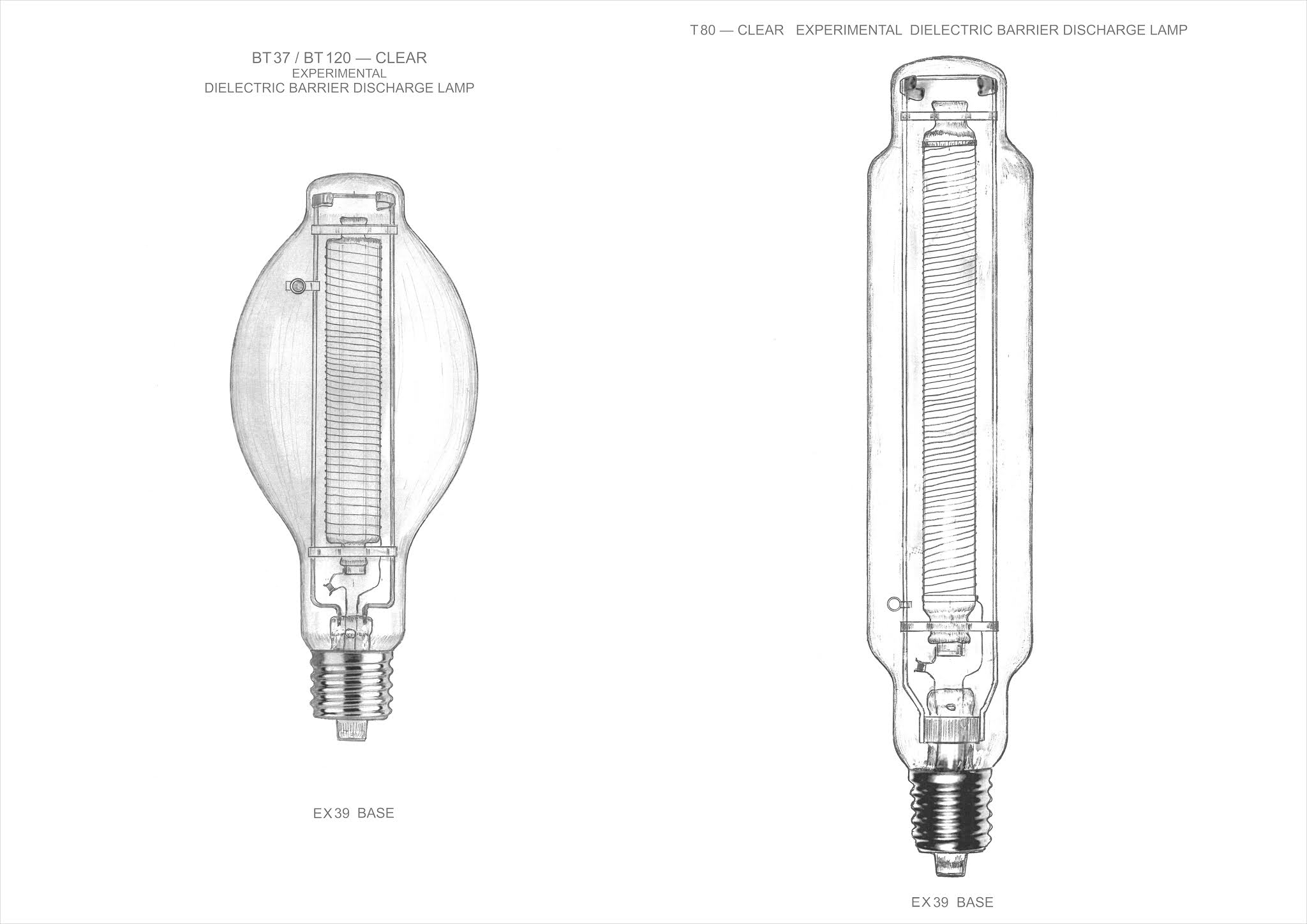
Depiction of experimental dielectric barrier 
high pressure discharge lamps
with annular arc-tube and coaxial external electrodes
ED28/ED90 and ED37/ED120 outer bulb, EX39 base


Q - Let we look back to the previous post and try a comparative description with the fluorescent medium pressure mercury lamp?
A - Here it is: https://lightcommunitylighting.blogspot.com/2020/08/blog-post.html.

Q - What is it intended to be, how to look like?
A - An excimer lamp, in a form of a HID lamp, shaped as an ED/BT fluorescent coated bulb with an E(X)39/40 screw cap.

Q - Was ever manufactured a similar lamp?
A - Not in this form, but researchments were conducted in order to bring the excimer lamps into 'visible light'.

Q - Do you consider a researchment of all components from scratch, or do you rather consider to put together components that are already 'on market'?
A - At this stage, for now, the intention is to put together what is already at disposal, thus some components might be particularly shaped.

Q - So, what do you need to put together in order to achieve the desired lamp, - the excimer lamp with visible light output?
A - Roughly, all the main component parts of a HID lamp; - arc-tube, frame, outer bulb, stem, screw-cap: http://lamptech.co.uk/Documents/M1%20Introduction.htm

Q - So, have we in this case too, as also in the previous case of medium pressure UV lamp, the excimer lamp 'as is' as (instead of) the arc tube of a HID ED/BT shaped lamp?
A - Yes, the case is the same.

Q - And, what parts of the known HID bulb have to be particularly shaped?
A - The frame, in a way as shown on left in the depiction above, and also in the previous post http://lightcommunitylighting.blogspot.com/2018/12/blog-post_18.html in order to hold the excimer lamp as an 'arc tube'. More exactly, the frame has to be fixed on (around) the stem and the end dimple as well, due to the bigger size of the excimer lamp comparative to the HID arc tubes.
  And, of course, the excimer lamp itself, in order to become the 'arc tube' of the new lamp. Some excimer lamps have a larger socket at one end, which is unnecessary, and it has to be removed.
  
Q - What about the arc-tube (in fact the 'on market' excimer lamp, in the experiment)? What is the preferred range of power for the desired lamps? But, first of all, what kind of 'pressure' of lamp does it has to be, as long as it is also a discharge lamp?
A - We will see,... but, in any way it needs to be a 'high pressure excimer lamp'.

Q - OK! Let's see then! To what degree does the excimer lamps resamble the arc-tube of a HID lamp, or the 'medium pressure UV lamp'? We consider a certain resemblance to be needed, so that the excimer lamp need to fit inside the outer bulb used for HID lamps, isn't it?
A - Yes, there is at least the need that the excimer lamp fit inside an ED/BT bulb, of at least ED28/ED90, or larger. The more, the frame with the mounted excimer lamp has to pass through the neck of the outer bulb during the assembling.

Q - Can you give some examples of excimer lamps which fit inside of ED28/ED90 or ED37/ED120 outer bulbs?
A - Yes! We'll see it together...

Q - Can we have one example of excimer lamp that fits into an ED28/ED90 outer bulb?
A - Consider this one:  https://www.researchgate.net/publication/234935849_Efficient_XeI_excimer_ultraviolet_sources_from_a_dielectric_barrier_discharge  Power-75W; arc-tube: outer dia-30mm; length-80mm; pressure up to 1bar; voltage-4.5...10kV, 125...375kHz; XeI* UV-253nm. 
 This is another example using a similar arc-tube, outer dia-30mm; length-80mm: https://www.researchgate.net/publication/224487405_Investigation_of_high_efficient_excimer_UV_sources_from_a_dielectric_barrier_discharge_in_rare_gashalogen_sources  - Power-40W; pressure up to 800mbar; voltage~3.5kV; KrCl* UV-222nm.
Imagine it roughly like the left one in the depictions above, thus is it not that.

Q - Can we have another example of excimer lamp that fits into an ED37/ED120 outer bulb?
A - Let's say, this one: https://patents.google.com/patent/WO2014148325A1/en - Arc-tube (quartz glass): outer dia-16mm; length-170mm; pressure~15KPa; VUV-172nm.
In the depiction on top, the image on right resambles it at best, but the same, not that is.

Q - Can you give an example of fluorescent coated excimer lamp, or at least of a paper about?

Q - Now, as we have also certain examples, what kind of fluorescent coatings can we expect to be suitable?
A – As in the previous post, there will be the fluorescent coatings as there are used for color light fluorescent tubes and neon signs. And, now there is a much greater expectance for a proper working, due to the moderate temperature of the excimer lamp.

Q - So, there will be no need to oversize the outer bulb in order to achieve a lower temperature on the fluorescent coating?
A - It is so by so 'oversized', if we put it that way. For instance, the 75W excimer lamp (in example above) fits barely inside the ED28/ED90 outer bulb. But what you need is also a sufficient area of the outer bulb, so the research only will answer.

Q - The depictions above show an EX39 type of socket, which we know to be used for protected metal halide lamps designed for unclosed lighting fixtures. Is it somehow the case for these excimer lamps too?
A - No! It's not.
The scope of this particular screw-cap, EX39, is chosen in the context in which we have also designed a special EX39 lampholder to be used for high voltage lamps.
 The solution of the EX39 was 'borrowed' because it allowed us to design this lampholder with a shield (collar), that in-goes the space between the 2 contacts of the lamp, in order to prevent arcing from the high voltage: 
So, in this case, it has nothing common with unclosed lighting fixtures. But in no case will our proposed excimer lamps be used in common EX39 lampholders, or in other common E39/E40 ones.
Consider this lamp to be researched together with our special proposed EX39 porcelain lampholder.


Q - Now! Back, about the fluorescent powders, you claim to be that ones used for low pressure mercury lamps. As these are known to be designed as most sensitive for 254nm, do we have excimer lamps emitting UV at these range? It seems that the only one is the XeI* lamp.
A - If we go to the patent linked above, we find that the fluorescent excimer lamp proposed for lighting is a VUV one, with 172nm emission. It uses almost successful the fluorescent coatings for 254nm.
It's an example that you have to question everything and to be open to possibilities. Rigid belief system limits you more than anything...
- If we also go to this patent https://patents.google.com/patent/US3778662A/en we find that "...many conventional fluorescent phosphors which are normally excited by prior art fluorescent lamp discharges with atomic radiation of primarily 2,537 A. U., are even more sensitive to the far ultraviolet ionic radiation in the range of 1,600 to 2,300 A".

Q - Is there still another gas or another fluorescent coating that might be involved for these excimer lamps?
A - Yes! There are the He2* (74nm) and the Ne2* (83nm) excimer lamps:
"Type 251 phosphor is responsive to the 74 nanometer neon radiation, and emits a green colored light, that in combination with some of the neon red light, produces an amber light.", thus this patent is not about excimer lamps.
- Take also in consideration the fluorescent coatings used for high pressure mercury lamps, that are appreciated as sensitive to the near UV wavelengths. In this respect, let's go back to the link to the  above publication and think at the XeF* (354nm), I2* (342nm), and XeCl* (308nm).


more content to come...


EX39 Bulb base  detail
[image only for illustration and educative purposes]


Useful links:

High efficiency fluorescent excimer lamps: An alternative to mercury based UVC lamps
https://www.researchgate.net/publication/286820995_High_Efficiency_Fluorescent_Excimer_Lamps_an_Alternative_to_CFLs_and_White_Light_LEDs

Fluorescent excimer lamps


Saturday, 8 August 2020

The Fluorescent Medium Pressure Mercury Lamp


A source of large variety of light colors for esoteric use


Q and A - Researchment questions and expectations


Depiction of Medium Pressure Mercury Lamps
with Oversized Arc-tube and Outer Bulb
(lamps are shown as clear, for a better understanding)


Q - What is it intended to be, how to look like?
A - A medium pressure mercury lamp, in a form of a HID lamp, shaped as an ED/BT fluorescent coated bulb with an E33 or E(X)39/40 screw cap.

Q - Do you mean an E33 size of lamp screw cap, beside of the well known large ones?
A - Consider it as been in the way described here: http://lightcommunitylighting.blogspot.com/2018/01/e33-screw-caps-and-lampholders.html

Q - Was ever manufactured a similar lamp?
A - Yes, there is, and you find more details here: http://www.lamptech.co.uk/Spec%20Sheets/D%20MA%20GEC%20MAF400.htm
    But thus is it the closest to what in discussion here, it is similar to only a certain extent.

Q - Do you consider a researchment of all components from scratch, or do you rather consider to put together components that are already 'on market'?
A - As long as it is intended to be a lamp for limited purposes, for sure, the intention is to put together what is already at disposal.

Q - So, what do you need to put together in order to achieve the desired lamp?
A - For sure, all the main component parts of a HID mercury lamp; - arc-tube, frame, outer bulb, stem, screw-cap. http://lamptech.co.uk/Documents/M1%20Introduction.htm

Q - What about the arc-tube? What is the preferred range of power for the desired lamps?
A - We consider it from 75W to 400W.

Q - Do you somehow mean that some medium pressure UV lamps on the market, as there are, might be the arc tube, inside an ED/BT outer bulb, for your proposed lamp, at least in the research stage?
A - You are right.

Q - OK, but if we look for the medium pressure UV lamps, we find them as usual in the range of 1KW to even tens of KW, - isn't it?
A - Yes it is, but if you are in knowledge, you would say: Stop! You have missed the lamps used for photochemical reactors, that are as usual in the range of 125W, 250W, 400/450W, and even more,... and, the more, their UV spectrum has peaks at 254nm, 356nm and 365nm, and have also starting electrode.
As another example, you find also 400W medium pressure mercury UV lamps (arc tubes) which burn in any position (not only horizontal), which are 31mm arc length, 14mm dia, and burn at 3,5A, 125V arc voltage, and roughly the same UV spectrum, but have no starting electrode.

Q - Yes, but you speak about even lower power, as low as 75W. Are there somewhere medium pressure UV lamps of so a low power?
A - Yes, there are on the market some lamps for photochemical reactors, of 150W dimmable as low as 75W.

Q - What about the outer bulb? Is it intended to be the same used for high-pressure mercury lamp used for general lighting?
A - Yes. The outer bulb (see image above) is the same, but it has to be at least one size larger than that corresponding to the same power of high pressure mercury lamps; i.e. for 75-125W medium pressure mercury the outer bulb has to be of ED28/ED90 size; for 250W it has to be of ED/BT37, ED/BT120, while for 400/450W it has to be of ED145/BT46/BT150.

Q - So, let say, for the first example, we will have an ED28/ED90 fluorescent coated bulb of 75-125W, - isn't it?
A - Yes, you are right! It is similar to the coated 175/250W high pressure mercury lamp.

Q - But there is seemingly one more problem. What about the fluorescent coating? 
A - Now, the problem comes, and it's maybe the most difficult one. It's the one where unpleasant surprises might come during the research... 

Q - Would you consider to use certain luminophores 'as there are' or rather would you try to develop new ones, consisting of mixtures of active substances?
A - For first, the desire may be to use fluorescent coatings as there are used for color light fluorescent tubes and neon signs, and as case might be, mixtures as well.


Q - OK! But you speak about lamps with color light output. And, as you also say, we know that most, if not all, nowadays fluorescent coatings for UV conversion in color light are used in fluorescent tubes, CFLs,  and neon signs.
So, are you sure that if you use these coatings in an 'as-is' form, will these be proper for the compact ED/BT bulb working at high temperature? And will these coatings have a proper conversion for the UV into the colors of light as there work in fluorescent tubes, CFLs, and neon signs?
A - You are right! Here the problem comes in! And here the 'surprises' as well. Only due to testing one by one of the fluorescent coatings would you draw a conclusion...


Q - Is this why you consider to have an oversized outer bulb, to have a lower temperature for the fluorescent coating?
A - Yes, this is one of concerns, of course. And, the more, the ED-shaped bulbs have somehow a larger area than the BT-shaped of the same size, so the 'ED' ones might be preferred.


Q - Can you already expect something as a result, concerning the fluorescent coating?
A - At this stage is too early even to estimate or to speculate, before you have at least some certain results after testing. Anyway, the best desired outcome (preferable with as few testing as possible) will consist in achieving a coating which is sensitive for the peaks of UV spectrum of the medium  pressure mercury lamp, but in order to result a light output efficiency of at least 70lm/W.

Q - Do you mean 70lm/W for any color?
A - For sure not! We mean 70lm/W for the standard white colors used in general lighting, of 2700 to 6500K.


Q - In this case, it seems you consider this type of lamp to be also useful for general lighting. Right?
A - Not necessary at this stage, but as the case might be, if successful, yes. But for now, the intent to achieve the white standard colors is only for the research purpose itself, to find how the results are in comparison with the high pressure mercury lamps and the fluorescent tubes. So, this might be in study at first, and thereafter other color lights will be in study as well.


Q - The depiction above shows uncoated lamps, with clear outer bulb. How does it fit, as long as the research intends to develop fluorescent lamps?
A - Bulbs are shown as been clear (uncoated) for a better understanding of the inside. But, if you ask it, the answer is: Yes, there are needed also the uncoated bulbs. The research will need them for reference, to find the lumen output of the medium pressure mercury lamps, as there are.


Q - What kind of glass has to be the outer bulb, and how large has it to be, for the clear (uncoated) experimental lamps?
A - It has to be the same used for coated bulbs, the same borosilicate glass used for the high pressure mercury lamps, of the size previously discussed. Consider the lamp the same, excepting the fluorescent coating. However, in some cases, if you need to find the UV spectrum of the assembled lamp, then you need also the outer-bulb to be transparent to UV.

Q - So, are you interested to block the UV and to get only the visible light from the uncoated lamps, in most of cases?
A - Yes, excepting some cases, we have to find out only the visible light output of the lamp and other working parameters as well. Measurements made on only the arc tube alone, as are for UV usages, are not conclusive, so we need it in the form and shape of the desired lamp, for also the other measurements, as described above.

Q - Is it true that you seek, or even the research is lucky for,  the case in which you have the optimal burning temperature for the arc tube, while the maximal temperature of the outer bulb at which the fluorescent coating still works properly on long term?
A - Yes! Exactly! This balance is the success of the experiment.

Q - Does the arc-tube need to be in vacuum inside the outer bulb, in order to remain hot while not heating too much the coating?
A - Most likely, yes. And the arc-tube might also be heat-reflective coated at ends.

Q - And, are you sure that with an outer bulb with one size larger than 'normal' would you find this balance?
A - Not! But this has to be the starting point for the experiment.

Q - Do you expect the same colors or color saturation as are for fluorescent tubes?
A - For sure not! You have to take into account that beside the conversion of the UV-C into visible, you have also a certain amount of visible light output. And, on the other hand, if you try to convert also the resulting UV-A into visible, this will also change the spectrum.

Q - Is it possible to get a jumble of unexpected wavelengths conversion leading to unexpected colors, too?
A - There is the likelihood to have unexpected colors that differ to an extent and saturation from that corresponding to the 254nm conversion. The more, if you use mixtures with phosphors for the near UV conversion.

Q - So, have we to expect softer colors (than in fluorescent tubes) due to the bluish-white visible light and due to the conversion of UV-A into visible?
A - We can only speculate so an outcome, but also in this case only the research will give the final result. Surprises may come out, pleasant or unpleasant, as well. But you have to be open to all possibilities...

Q - The most reasonable expectance of the research success?
A - The 75-125W medium pressure UV arc-tube in the ED28/ED90 outer bulb, coated with fluorescent powders used for CFLs of all types, including the high powered for aquarium, hydroponics, and others.

Q - As a conclusion for the attempt to use the coatings used in fluorescent tubes or neon signs for the HID lamps, even let's say of medium pressure mercury?
A - Realistically, you have to move your attention to other compact discharge lamps, with moderate heat output and narrow UV emission (similar to fluorescent tubes), as might be excimer lamps. 
However, excimer lamps are an immature technology from many points of view, while the mercury lamps, as a whole, are a mature one from almost all points of view.
And, for a comprehensive answer, you have to put in balance the disadvantages (as possible mismatching, as resulting from above) of the mature technology of the mercury lamps (as a whole) with the advantages of the still immature technology of excimer lamps.

Q - And, the balance weights in favor of...?
A - The mercury lamps as a whole (fluorescent tubes, CFLs, medium pressure UV, HIDs) at least nowadays, and even, either to proof the maturity of their technology (in case of lack of success of this experiment), or to improve their maturity and portfolio, as the case might be, with the success of this research. May it be even partially or barely successful. 

some more content might come...


Image of medium pressure fluorescent coated mercury lamp with oversized outer bulb (BT46/BT150 for 400W lamp) and arc-tube


Notice!
The oversize of the arc-tube (comparative to that of high pressure mercury lamps) is not a sine-qua-non condition for the lamps in discussion, but the oversizing of the outer bulb is one.


Related post: https://lightcommunitylighting.blogspot.com/2018/05/blog-post_30.html


Cobra's up to date post: http://2012portal.blogspot.com/2020/08/eostres-gift-update.html


Wednesday, 8 July 2020

Filament LED Bulb with Synthetic Gemstone Tube


OPEN SOURCE EVERYTHING


Please read at first about the Xenon HID Lamp with Synthetic Gemstone 'Protection Tube'
https://lightcommunitylighting.blogspot.com/2018/08/blog-post.html


[Images are only for illustration and educative purposes]

No depiction available for moment!


Related posts: https://lightcommunitylighting.blogspot.com/search?q=synthetic

Notice!  
[Related to the case of the Xenon HID lamp with synthetic gemstone tube]
> Instead the ‘metal halide’ arc-tube you have a 'filament LED' of 6500K, which gives an almost day-light white, but however not as a day-light spectrum (as in case of the Xenon HID lamp).

> Instead of the protection tube of the ‘protected metal halide lamp’, you have a ‘synthetic gem’ tube, which allows the ‘day light’ of the white filament-LED to pass through the synthetic gem tube.


Discussion to continue...