Showing posts with label high pressure. Show all posts

Monday, 8 March 2021

The Neon Medium/High Pressure Arc-discharge Lamp


OPEN SOURCE EVERYTHING  QUESTION EVERYTHING


Q and A  A Discussion - Researchment, Questions and Expectations


Depiction of supposed ED28/ED90 HID Neon Lamps


Q - What is it intended to be, how to look like?
A - Consider it as the HID counterpart of the neon signs filled with neon, in the way as the Ar-Hg HID lamp is that counterpart of the neon-signs filled with Ar-Hg. 
Or, the HID version for neon, from the point of view of what means the HID mercury lamp.

Q - Was ever manufactured a similar lamp?
A - Not in a commercial form. But, as we know, long-time ago, there were some studies about, and some attempts to develop a compact HID neon lamp of this kind, with a higher lm/W red light, than so as were at that time the cold cathode neon beacon lights. But we do not have any papers from that time, nor would you find some satisfactory now.
 But you have instead a newer patent paper on this concern, that is really interesting. Here it is:

Q - Why do you think that development not continued?
A - Don't know anything more about, but supposedly problems with electrodes and arc tube erosion. Or, anything else.

Q - And now? Are there greater chances of success?
A - From a commercial perspective, not. You have now red LEDs, and you can achieve, if you want, ED28/ED90 (clear or diffusing) filament LEDs of red color, with even up to ten times more lm/W. (But for beacon red lights you need an amount of IR emission too, beside of the visible light output).

Q - Again the questions, as in previous cases.
 Do you consider a researchment of all components from scratch, or do you rather consider to put together components that are already 'on market'?
A - Again, as long as it is intended to be a lamp for limited purposes, the intention is to put together as possible what is already at disposal.

Q - So, what do you need to put together in order to achieve the desired lamp?
A - The same, all the main component parts of a HID mercury lamp; - arc-tube, frame, outer bulb, stem, screw-cap: http://lamptech.co.uk/Documents/M1%20Introduction.htm

Q - What about the arc-tube? What is the preferred range of power for the desired lamps?
A - Let consider it around 250W, at least for the research case. 

Q - No more or less, but only 250W?
A - Yes. Concerning the low lm/W of expected neon discharge, the 250W might be considered not too much, but also enough high for, let say a 15-20lm/W, for a reliable output.
However, the arc tube needs to be made of alumina silicate hard glass instead of quartz glass.

Q - So, what rate of success do you expect in development of the under discussion lamp, or do you expect a reliable success of the experiment?
A - Ask please rather, what problems do you expect or do you have to overcome (because there are, believe!), before to discuss about the success into achieving a lamp that is similar with the incandescent one in its lm/W output.

Q - Yes! Then, why the entire discussion about this experiment? Or, is it somehow also the case of the N2 and CO2 lamps, discussed in a previous post? 
Is it, let's say: - For the seek of the red light, and the idea itself, and also for the seek of research and portfolio of discharge lamps as a whole.
A - Hmm!... You guess it already...

Q - OK! but in that previous post you mean that: - You have now at disposal the dielectric barrier discharge lamp in a more advanced stage of development, so you can use it from start, in case of gases that are not 'noble'. But why do you not use it also for neon discharge, if there are or might be so big problems using a common HID lamp?
A - It leads very likely into excimer formation, so you get an excimer lamp, rather than a simple gas discharge lamp. And, yes! You have already neon excimer lamps, but as a source of far UV (VUV), not as one of red light.

Q - In earlier posts you speak about the neon-mercury HID lamp. Is this somehow a similar HID lamp as the well known mercury lamp, but filled with neon beside the mercury, instead of argon?
A - No! Or it might be only, but only, in its appearance, not as functionality. What we mean by the neon-mercury HID lamp is a lamp in which the main discharge remains in neon.
 - If you build a HID lamp with neon and mercury (similar to the mercury lamp with argon), after the warm up of the lamp, the mercury discharge will take over entirely the discharge process. It will simply keep out the neon gas to be longer involved in the discharge, instead keeping the neon only as a buffer gas. And this might be the case of 100 to 1, neon to mercury amounts, in pressure units of the hot lamp, or even more.

Q - And?!...
 A - Briefly, what have you to do is to rise up the difference, as much more neon and much less mercury, or to 'deplete' the mercury in the discharge process. And, in the case of medium or high pressure discharge,... anything but easy might it be...

Q - So, which one do you consider?
A - The first one, of course. The more, as long as you don't look to achieve a constant color or a constant lumen output.

Q - And, in what difference of neon and mercury pressure?
A - Again, only the research will answer, but,... as a speculation,... an 1000 to 1 would not be a surprise.

Q - In a previous post
you speak about a 'medium pressure neon-mercury discharge lamp', and that: It's main light spectrum is expected to come out from the discharge itself, and will be a reddish based spectrum. Let's say from light cyclamen to violet red, depending of the balance between neon and mercury (in discharge terms, not in 'weights').
How do you expect the spectrum depending on neon and mercury pressures? When cyclamen and when violet-red?
A - This is the desire, the goal of the experiment with neon-mercury HID lamp. In any way, it seems more easy for light cyclam, and more difficult for violet-red.

Q - Why so?
A - If you bring more blue and violet wavelength into the neon discharge, you will most likely get different nuances of cyclam or pink. It's about mixing wavelengths. In the plasma the wavelengths will 'mix'. But this is another subject. The violet-red will rather come out from the pure neon discharge with a violet glass, as a rough speculation. But with an efficiency that for sure will you consider inconvenient.

Q - Are the desired lamps expected to start directly, or would it be necessary a high voltage pulse.
A - Let's say, directly, at the supply voltage (of 220/230V) in case of internal starting electrode (and reactor ballast).


more content to come...


Tuesday, 1 September 2020

The Fluorescent Excimer Lamp


Another kind of source of light colors for esoteric use and general lighting


Q and A - Researchment proposal, questions and expectations


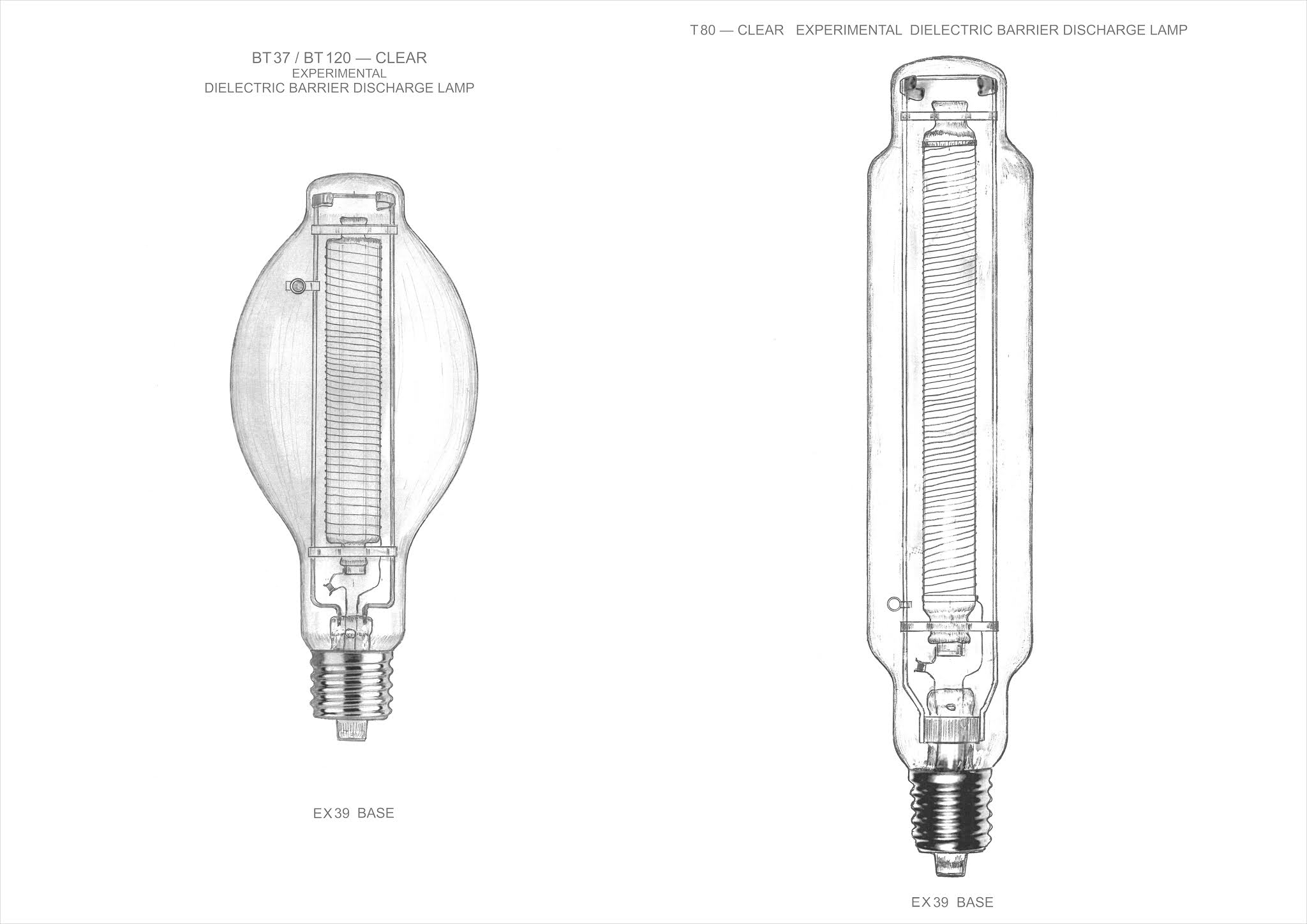
Depiction of experimental dielectric barrier 
high pressure discharge lamps
with annular arc-tube and coaxial external electrodes
ED28/ED90 and ED37/ED120 outer bulb, EX39 base


Q - Let we look back to the previous post and try a comparative description with the fluorescent medium pressure mercury lamp?
A - Here it is: https://lightcommunitylighting.blogspot.com/2020/08/blog-post.html.

Q - What is it intended to be, how to look like?
A - An excimer lamp, in a form of a HID lamp, shaped as an ED/BT fluorescent coated bulb with an E(X)39/40 screw cap.

Q - Was ever manufactured a similar lamp?
A - Not in this form, but researchments were conducted in order to bring the excimer lamps into 'visible light'.

Q - Do you consider a researchment of all components from scratch, or do you rather consider to put together components that are already 'on market'?
A - At this stage, for now, the intention is to put together what is already at disposal, thus some components might be particularly shaped.

Q - So, what do you need to put together in order to achieve the desired lamp, - the excimer lamp with visible light output?
A - Roughly, all the main component parts of a HID lamp; - arc-tube, frame, outer bulb, stem, screw-cap: http://lamptech.co.uk/Documents/M1%20Introduction.htm

Q - So, have we in this case too, as also in the previous case of medium pressure UV lamp, the excimer lamp 'as is' as (instead of) the arc tube of a HID ED/BT shaped lamp?
A - Yes, the case is the same.

Q - And, what parts of the known HID bulb have to be particularly shaped?
A - The frame, in a way as shown on left in the depiction above, and also in the previous post http://lightcommunitylighting.blogspot.com/2018/12/blog-post_18.html in order to hold the excimer lamp as an 'arc tube'. More exactly, the frame has to be fixed on (around) the stem and the end dimple as well, due to the bigger size of the excimer lamp comparative to the HID arc tubes.
  And, of course, the excimer lamp itself, in order to become the 'arc tube' of the new lamp. Some excimer lamps have a larger socket at one end, which is unnecessary, and it has to be removed.
  
Q - What about the arc-tube (in fact the 'on market' excimer lamp, in the experiment)? What is the preferred range of power for the desired lamps? But, first of all, what kind of 'pressure' of lamp does it has to be, as long as it is also a discharge lamp?
A - We will see,... but, in any way it needs to be a 'high pressure excimer lamp'.

Q - OK! Let's see then! To what degree does the excimer lamps resamble the arc-tube of a HID lamp, or the 'medium pressure UV lamp'? We consider a certain resemblance to be needed, so that the excimer lamp need to fit inside the outer bulb used for HID lamps, isn't it?
A - Yes, there is at least the need that the excimer lamp fit inside an ED/BT bulb, of at least ED28/ED90, or larger. The more, the frame with the mounted excimer lamp has to pass through the neck of the outer bulb during the assembling.

Q - Can you give some examples of excimer lamps which fit inside of ED28/ED90 or ED37/ED120 outer bulbs?
A - Yes! We'll see it together...

Q - Can we have one example of excimer lamp that fits into an ED28/ED90 outer bulb?
A - Consider this one:  https://www.researchgate.net/publication/234935849_Efficient_XeI_excimer_ultraviolet_sources_from_a_dielectric_barrier_discharge  Power-75W; arc-tube: outer dia-30mm; length-80mm; pressure up to 1bar; voltage-4.5...10kV, 125...375kHz; XeI* UV-253nm. 
 This is another example using a similar arc-tube, outer dia-30mm; length-80mm: https://www.researchgate.net/publication/224487405_Investigation_of_high_efficient_excimer_UV_sources_from_a_dielectric_barrier_discharge_in_rare_gashalogen_sources  - Power-40W; pressure up to 800mbar; voltage~3.5kV; KrCl* UV-222nm.
Imagine it roughly like the left one in the depictions above, thus is it not that.

Q - Can we have another example of excimer lamp that fits into an ED37/ED120 outer bulb?
A - Let's say, this one: https://patents.google.com/patent/WO2014148325A1/en - Arc-tube (quartz glass): outer dia-16mm; length-170mm; pressure~15KPa; VUV-172nm.
In the depiction on top, the image on right resambles it at best, but the same, not that is.

Q - Can you give an example of fluorescent coated excimer lamp, or at least of a paper about?

Q - Now, as we have also certain examples, what kind of fluorescent coatings can we expect to be suitable?
A – As in the previous post, there will be the fluorescent coatings as there are used for color light fluorescent tubes and neon signs. And, now there is a much greater expectance for a proper working, due to the moderate temperature of the excimer lamp.

Q - So, there will be no need to oversize the outer bulb in order to achieve a lower temperature on the fluorescent coating?
A - It is so by so 'oversized', if we put it that way. For instance, the 75W excimer lamp (in example above) fits barely inside the ED28/ED90 outer bulb. But what you need is also a sufficient area of the outer bulb, so the research only will answer.

Q - The depictions above show an EX39 type of socket, which we know to be used for protected metal halide lamps designed for unclosed lighting fixtures. Is it somehow the case for these excimer lamps too?
A - No! It's not.
The scope of this particular screw-cap, EX39, is chosen in the context in which we have also designed a special EX39 lampholder to be used for high voltage lamps.
 The solution of the EX39 was 'borrowed' because it allowed us to design this lampholder with a shield (collar), that in-goes the space between the 2 contacts of the lamp, in order to prevent arcing from the high voltage: 
So, in this case, it has nothing common with unclosed lighting fixtures. But in no case will our proposed excimer lamps be used in common EX39 lampholders, or in other common E39/E40 ones.
Consider this lamp to be researched together with our special proposed EX39 porcelain lampholder.


Q - Now! Back, about the fluorescent powders, you claim to be that ones used for low pressure mercury lamps. As these are known to be designed as most sensitive for 254nm, do we have excimer lamps emitting UV at these range? It seems that the only one is the XeI* lamp.
A - If we go to the patent linked above, we find that the fluorescent excimer lamp proposed for lighting is a VUV one, with 172nm emission. It uses almost successful the fluorescent coatings for 254nm.
It's an example that you have to question everything and to be open to possibilities. Rigid belief system limits you more than anything...
- If we also go to this patent https://patents.google.com/patent/US3778662A/en we find that "...many conventional fluorescent phosphors which are normally excited by prior art fluorescent lamp discharges with atomic radiation of primarily 2,537 A. U., are even more sensitive to the far ultraviolet ionic radiation in the range of 1,600 to 2,300 A".

Q - Is there still another gas or another fluorescent coating that might be involved for these excimer lamps?
A - Yes! There are the He2* (74nm) and the Ne2* (83nm) excimer lamps:
"Type 251 phosphor is responsive to the 74 nanometer neon radiation, and emits a green colored light, that in combination with some of the neon red light, produces an amber light.", thus this patent is not about excimer lamps.
- Take also in consideration the fluorescent coatings used for high pressure mercury lamps, that are appreciated as sensitive to the near UV wavelengths. In this respect, let's go back to the link to the  above publication and think at the XeF* (354nm), I2* (342nm), and XeCl* (308nm).


more content to come...


EX39 Bulb base  detail
[image only for illustration and educative purposes]


Useful links:

High efficiency fluorescent excimer lamps: An alternative to mercury based UVC lamps
https://www.researchgate.net/publication/286820995_High_Efficiency_Fluorescent_Excimer_Lamps_an_Alternative_to_CFLs_and_White_Light_LEDs

Fluorescent excimer lamps